Passages: on the Rue des Thermopyles

“It was a beautiful street. The street of homeless cats, she often thought. She never came into it without seeing several of them, prowling, thin vagabonds, furtive, aloof, but strangely proud. Sympathetic creatures, after all.” – Jean Rhys, Quartet

By Anna Evans:

In the fourteenth arrondissement of Paris, starting from Metro Denfert-Rochereau. On the trail of passages and impasses, courtyards and gardens. With a scattering of notes and addresses to guide us through our route. Wide streets branch off in different directions from the centre, where the great lion looks out. We walk along the Avenue d’Orléans, renamed Avenue General Leclerc after the liberation of Paris. The old street name has been retained only crossed out. Strikethrough: a line drawn through, as though to keep the name still present. 

Along Rue Daguerre, past the pink house that was Agnes Varda’s, there are patterns of white cloud where the sun is starting to break through, to dazzle. The elegant white facades of the buildings appear lighter, so that the street seems to open to us, as we absorb the decorated iron balconies, shutters and flowers in window boxes, pavement cafés, and glimpses in shop windows. We like to spot the launderettes and tabacs, the neighbourhood shops and bakeries.

In Place Jacques Demy, in a square shaded by trees, we sit and drink coffee. In the park there are basketball courts and ping pong tables. An old merry go round and tables with chess squares painted over them, a few old books left there for the taking. The sun makes patterns through the trees.

In photographs taken along the way are glimpses in passing of buildings and streets. Compositions of a moment in time. Walking along the Rue des Plantes in search of an impasse. Impasses, the streets that come to a dead end, a cul-de-sac, that most evocative of Parisian place names: a passage with no way through. 

The Impasse du Moulin Vert. An enclosed passage, a cobbled street with the feel of a village. There are houses and buildings of different styles, statues and carvings, hidden entrances. Gates conceal gardens and terraces, trees growing tantalizingly across the walls. At the end of the passage, a courtyard with old style lamps and green shutters on the windows. There are pots of flowering plants, pink roses, geraniums, and begonias. An elegant pink and white building with iron balconies and ivy growing up its side. Shadows of trees make patterns on the walls.

The streets of this area, Pernety, have the feel of another time. Narrow streets and smaller houses, shutters and chimneys mingle with Haussmann-style facades. Enclosed gardens tucked away behind trees and railings, with enticing corners to sit and read among grass and sunlight, green and shaded. The village meets the city as people gather with friends or pause to eat their lunch, making use of the space, scattered sounds of music.

A mural with flowers and bold lettering along the wall, the words of Louise Michel, a revolutionary of the Paris Commune: La révolution sera la floraison de l’humanité comme l’amour est la floraison du coeur[1]. 

Turning the corner to find a passage, the Rue des Thermopyles, a narrow street paved with cobblestones that feels quiet and secluded. There are low-rise houses linked by leafy arches, blue shutters, and red flowering roses. Some of the buildings seem like artists’ studios, the sense of Montparnasse in another time. Climbing vines and wisteria grow across the passage and trail between the houses and branches cover windows. Window boxes and planters, pots of different shapes and sizes, imperfect, unexpected, like a story opening outwards.

On the corner is a yellow house with a black painted door, creepers grow across the building and pots of plants and flowers. We hear music, the sound of a piano through the open window and a voice singing, soaring like a moment in a film. Each day, a reel of moments. 

Looking back along the cobbled lane there is a sense of green everywhere, hushed voices from the shared garden. The shade of trees and dappled sunlight, rooftops, and blue sky. Each glimpse is like framing a different fall of shadow and sunlight and sometimes the street seems to lengthen depending on the angle I look, as figures emerge and fade into the space of the passage and around corners. I want to notice every detail, to know the story behind every door.

Cats emerge from behind windows, unobtrusively free, and stroll along the cobbled alleyway looking for a patch of sunlight to sprawl under. I think of the city as viewed by its cats, who prowl its spaces, its hidden courtyards, and enclosed places. For the cats there are escape routes in every dead end, and no forbidden entrances. 

We take our time, absorbing every angle, torn between the wish to linger here, and the draw of the blue sky ahead and what comes next; of what other hidden places we might find. The city becomes an endless series of movements, experienced in passing. A passage is made to be followed.

***

Notes: [1] The revolution will be the flowering of humanity as love is the flowering of the heart.

Anna Evans is a writer from Huddersfield who lives in Cambridge, with interests in place, memory, literature, migration, and travel. She enjoys writing about landscape – nature, cities, and all the places in-between. You can read more about Anna and her work on her website The Street Walks In. You can find more of Anna’s contributions to Elsewhere here.

Film: Surprise View by Sarah Alwin and Patrick Wray

By Sarah Alwin:

When I come here it is not the quiet of the landscape that I experience but the residual resonances of the city which unsettle my head and my heart. It is a place of outlandishness and of natural and stinging beauty. Its impertinence is overwhelming. This space is full of busyness and clarity and colour. 

My friend Patrick Wray made the music for this piece, knowing that there was noise and strangeness in this. His music glues this work together.

I took these photographs from the end of 2019 to the start of 2023 at Surprise View, a ten minute drive from my home in Sheffield. I filtered the digital images with my printer and scanner and by stitching into them. What used to be a source of frustration (my beleaguered printer running out of ink) has become, for me, a new way of seeing this beloved place.

***

Patrick Wray is an artist and bookseller based in London. He recently published 'Ghost Stories I Remember' with Colossive Press. For more about his work visit his website.
Twitter / Instagram

Sarah Alwin is a special needs and English tutor and writes about domestic space in South East Asian literature. She lives in Sheffield and co-produces and co-hosts a weekly review programme, Radioactive, for community radio at Sheffield Live 93.2FM.
Twitter / Instagram

What We See: Joseph Roth and Our Berlin – A call for submissions

On the 11 March 2023 at Lettretage in Berlin, Elsewhere: A Journal of Place is co-hosting an evening of discussion about the writer Joseph Roth and a series of readings inspired by his writing. We are looking for writers in Berlin to join us at the event…

"What I see, what I see. What I see is the day in all its absurdity and triviality. A horse, harnessed to a cab, staring with lowered head into its nose bag, not knowing that horses originally came into the world without cabs; a small boy playing with marbles on the sidewalk. He watches the purposeful bustle of the grownups all around him, and, himself full of the delights of idleness, has no idea that he represents the acme of creation, but instead yearns to be grown up; a policeman who fancies himself as the still point at the center of a whirlpool of activity, and the pillar of authority—enemy to the street, and placed there to supervise it and accepts its tribute in the form of good order."
—"What I See," Joseph Roth

Joseph Roth keenly observed the Berlin of the 1920s in his now-classic feuilletons, short reports on the city scene. How might he have seen Berlin today? We're looking for work that – like Roth – explores life in Berlin today, from the playful to the political. So whether you have read Roth’s pieces on Berlin or not, we are looking for contemporary short nonfiction pieces, scenes and sketches, mini-reportages and place-based essays about Berlin.

Together we will create a portrait of a city.

Need some inspiration? How about writing about one of Berlin’s underexplored curiosities, or unusual approaches to familiar places? Eavesdropping in one of the city’s many watering holes, at the barbershop or in a hotel lobby? A late-night visit to the train station or moving through the city by public transport? A profile of Berlin’s outsiders or newcomers? An early beer as the corner pub opens its doors to the morning sun?

All of these are the starting point for one of Roth’s Berlin stories, and he would certainly find plenty to write about if he were to use them again today.

Your submissions can be previously published or unpublished, but we would need you to be able to read at our event on the 11 March. We would also love to showcase the selected unpublished pieces here on Elsewhere as part of a Joseph Roth / Berlin series.

The details:

Language – English
Word Length – 500-1000 words
Send to – JosephRothToday@gmail.com 
Deadline – 24 February 2023
Eligibility – Must be available to read at Lettretage in Berlin at 7 PM on 11 March 2023

Who are we:

Sanders Isaac Bernstein, born in London, grew up in New Jersey (USA). His writing has appeared, among other places, in newyorker.comHypocrite Reader, and The Bad Version, which he founded and edited from 2011-2014. He has written on Joseph Roth for both Majuscule and Slow Travel Berlin. He holds a PhD in Literature from the University of Southern California.   

Julia Bosson is a writer originally from Ojai, California. Her work has appeared in publications such as BOMB, VICE, Guernica, and the Believer, among others. The recipient of grants from the Fulbright Program, DAAD, and the MFJC, she has been awarded fellowships and residencies from LABA Berlin, the Wassaic Project, Vermont Studio Center, Monson Arts, Woodstock Byrdcliffe Guild, and the Catwalk Institute. She currently teaches writing at the Cooper Union and resides in Berlin, Germany, where she is at work on a novel about the life and journalism of Joseph Roth.

Paul Scraton was born in the north of England and has lived in Berlin since 2002. He is the editor in chief of Elsewhere: A Journal of Place and the author of a number of books for Influx Press including Ghosts on the Shore: Travels along Germany's Baltic coast (2017) and the novella of the forest In the Pines (2021). He has written for New Statesman on the life and work of Joseph Roth and his next book explores the place of the forest in German cultural identity via a long walk in the Harz mountains, following in the footsteps of Heinrich Heine.

Alexander Wells is a freelance writer and critic from Australia. His reviews and essays—including one on Joseph Roth's urban miniatures—have been published by The Guardian, The Baffler and the European Review of Books among others. He is currently Books Editor for the print monthly Exberliner.

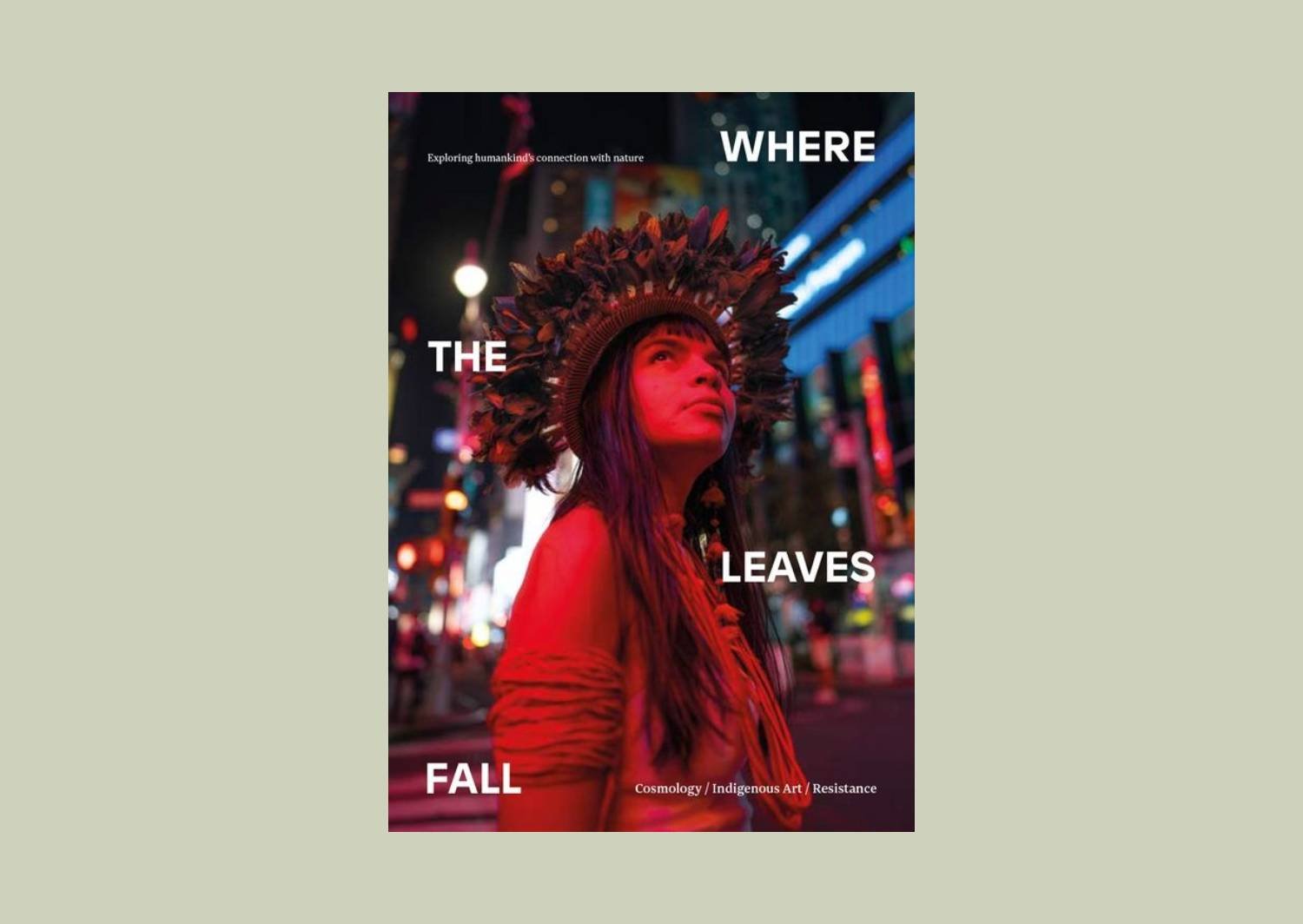
Printed Matters: Where the Leaves Fall

IMAGE COURTESY OF WHERE THE LEAVES FALL

By Sara Bellini

“Indigenous thinking breaks the extractive capitalist rationalism that looks at nature  the same way it looks at other people, aiming to dominate them. When looking at nature with a holistic sense, we understand that we are part of it and that we are connected to this planet.”

These words are taken from the editor’s note of Issue 12 of Where the Leaves Fall, entirely guest-edited by Indigenous activist Txai Suruí. The magazine regularly gives space to activists and Indigenous people from all over the world to share their experiences and their view of a sustainable future.

Where the Leaves Fall aims at exploring “humankind's connection with nature”, through articles, interviews, illustration and photography on the themes of art, agriculture, technology, science, philosophy, human rights and any field where our impact on the planet is visible. The commitment to rekindling our relationship with nature goes beyond articles on how climate change is linked with social justice. The entire production process of the physical journal is sustainable, from minimised paper waste to chemical free ink and a wormery to finish the staff food at the printing facility. 

The contributors to the journal are diverse, including marginalised voices from the global south, Indigenous people, women, people of colour and people from the LGBTQI+ community. Community, at a local as well as a global level, is fundamental to reach a more balanced relationship with the world we share. Where the Leaves Fall was born out of this shared value at OmVed Gardens, a space in north London - partnered with the UN World Food Program - promoting ecology and agricultural sustainability, where people can engage with and experience nature in creative ways. 

Below you’ll find our interview with editors Luciane Pisani and David Reeve.

Image courtesy of Where the leaves Fall

Why did you choose the print magazine as a format?

At the time we started there weren’t many magazines looking at climate breakdown through the lens of our connection with nature and print felt like a good way to take people away from digital spaces – including social media. We were very careful in how the magazine is printed – printing with one of the most environmentally friendly printers in the world - if you smell the magazine you won’t catch the whiff of any chemicals.

However with the pandemic and the various lockdowns and restrictions around that it became apparent we needed to go online as well. So we now encompass physical spaces for events, print, and online. One of our Australian collaborators recently told us our magazine is a message stick – you can look that up.

One of the focuses of WtLF is climate change. How do you turn feelings of anxiety, anger and hopelessness into a force for change?

It’s difficult to feel hope at a time of climate and societal breakdown. Systems that have held us up for so long are slowly collapsing and that’s creating a lot of discontent. Capitalism has failed us and the planet and we’re now in a system where politicians and industries are desperately trying to hold on to what they had and many people are being cast adrift. The growth of the far-right is a result of this. With the UK government’s indifference, the National Trust RSPB and WWF came together to create the People’s Plan for Nature to engage the public in caring and connecting with the natural world.

Similarly the UK government is largely ignoring the National Food Strategy that it commissioned so there’s a movement towards how people and business can take action and affect change. Rob Hopkins came up with the Transition Network (you can read an interview with Rob in the mag) which is all about communities coming together and reimagining the future. In Brazil you have movements such as the Cozinha Ocupação 9 de Julho and MST (Landless Workers’ Movement). Where governments and corporations fail us, people can come together and affect change - it’s about demonstrating that things can be done differently and work. 

What’s the importance of community and connection for you?

Our focus is on growing our local and global communities. Community is everything. It’s diversity. It’s understanding. It’s collaboration. It’s imagination. It’s strength. It’s power.

Could you share some details about your creative process, for example in regards to finding themes and selecting submissions?

The magazine is a project of OmVed Gardens – a space in north London that has undergone ecological transformation. We meet up there to discuss the things that people might want to focus on or talk about. From these meetings come the magazine’s themes. We then meet again to discuss initial ideas around those themes before casting the net out to our global audience. We have a period of submissions and then from the ideas developed at OmVed and the varying submissions, we select the features (text and photographic) and dialogues (shorter essays) for the mag.

For the 12th issue we wanted to do something different. Everyone was largely disappointed by the results of COP26. We watched the opening ceremony with some really impressive speeches – but were the ears in the auditorium listening? One of the speakers was Txai Suruí – an Indigenous activist from the Amazon’s Paiter Suruí people. In the lead up to COP27 we were interested in what the magazine would be if we asked Txai to edit the magazine, bringing her perspective to our readers at this crucial moment in the climate emergency.

We wanted to step back and allow her complete ownership of the editorial direction, and it has led to a series of fascinating features from the perspective of Indigenous peoples – mostly from the Amazon but also other parts of South America. As Txai said: “For a long time, the stories written about the Indigenous peoples of Brazil and the world were told through the eyes of the coloniser, almost always stereotyped and from a perspective of domination and superiority,” she writes. “We are now protagonists of our own history and the narrators of it - a history that didn’t start with the invasion. We continue our resistance that has lasted more than 500 years and that does not end now.”

It’s a powerful issue. As the shaman Davi Kopenawa states in the issue – we, the westerners, are the earth eaters. Our relationship with the land is one of extraction and destruction. It’s not about us saving Indigenous peoples but recognising that we need to open up and that they are the ones who can actually save us. They are amazing storytellers, artists and experts in conservation. They have a deep connection with the land and have survived and developed alongside it for 1000s of years. 

What did you learn about humankind’s connection with nature since issue 1?

We are nature and a part of the ecosystems in which we live. The rivers and seas run through our bodies. Our family includes the flora and fauna around us and the living soil under our feet.

Is there anything I haven’t asked you that you’d like to share with our readers?

If you’d like to know more about the magazine or become a part of the conversation then you can sign up to our newsletters, follow us on Instagram and check out the mag.

Hill Haven

The poet’s father on his tractor, by Bill Clark

By Carol Barrett:

After a poem by Craig van Rooyen

They aren’t moles. I’m told nights are too cold for moles in the high desert. Then what -- gophers? Ground hogs? Prairie dogs? In the damp soil west of the Cascades, moles were plentiful as robins. My father got his supply of traps at yard sales for two bits, some farmer having given up the harvest ghost. Whenever hills popped up, he’d dig down a few inches and lay them in, warn us to stay clear. He didn’t want an ankle enmeshed in the gears, a toddler’s curious hand clamped to the earth. When he got one, he’d announce it supper-time, bury the sleek body in the apple orchard, or along the edge of the woods, where alder leaves made for soft mulch.

I never looked one in the eye. But I spotted plenty of mounds, out digging potatoes or tearing corn from the stalk, peeling broad squash leaves back for a golden bonanza. One year a new ordinance forbid trapping them, on account of cruelty to animals. My father kept up his solution despite the risk. He figured, more humane than shooting them, and no law against that. He was especially perturbed when they dug up the lawn, clipped short for picnics of a summer evening, cedar table re-varnished every five or six years to restore what wind and rain had roughed up. The trap wasn’t an instant success. You had to wait for the critter to come up for air. It could take days, even weeks.

Here my hidden low-lifes stay quiet all winter, perhaps hibernating. But come spring, their handiwork pops up all over the yard. I scoop lush mounds into flowerpots for the pine seedlings that spring from ample cones. The soil is just right – combed and softened, free of roots, fine as biscuit dough. When I first started repurposing their primordial heaps, I feared I might slice one with the shovel, but it’s never happened. They dig their tunneled dugouts well below the planted surface. And they won’t cave in. When I tamp the excavated soil down, the lawn is flat as before the latest hill happened. In time the grass will spread across the brown moon, fill in with the help of whirling sprinkler.

We manage to co-exist. These creatures save their building frenzy for late at night when I’m already tuckered. When I open the door to a new day, I may find another hill to salvage for my tree farm, small but growing on the back deck. Sometimes I’m blessed with two or three, yards apart, a quick jaunt with the garden cart, sun on my neck. Life goes on as usual underground, my father’s ashes on a tunneled slope. He is getting acquainted with new friends, inviting them to watch reruns of Perry Mason, where it all turns out okay in the end, his pipe smoke mingling with the damp and porous earth.

***
Carol Barrett coordinates the Creative Writing Certificate Program at Union Institute & University. She has published two volumes of poetry and one of creative nonfiction. A former NEA Fellow in Poetry, Carol has lived in nine states and in England. She currently resides in the high desert of central Oregon. Her poems have appeared widely in literary magazines, and in over fifty anthologies.

Statue in Bronze and Andesite

By Fiona M Jones:

The North Berwickshire coast, from Eyemouth along past St Abbs, wanders through hills and cliffs and narrow fragmented shores. The North Sea, cold even in summer, has cut through centuries and rocks and history and lives. Last winter a vicious December storm swept away the whole autumn’s baby seals, and back in October 1881 nearly two hundred fishermen died at sea or capsized on the very point of reentering their harbours. 

History doesn’t say much about it: a major disaster to a string of very small communities. The story is kept now by a little bronze statue in the middle of the village of St Abbs: a group of women and children standing staring out to sea. The sea that had brought them food and now had taken their loved ones away. 

You are visiting St Abbs on a clear and pleasant weekend afternoon, buffeted a little by the wind and out of breath by the steepness of the path; dizzied perhaps by the vertical heights and awed by the wild beauty of the place. You sense a fierceness of landscape and sky, but it’s hard to imagine the time when fishermen battled the unforgiving North Sea with nothing but sail and oar—and didn’t always win. 

St Abbs itself sits in a partial hollow between cliffs that rise up like towers to break the sky and sea. The sea in turn breaks cliffs, serrating them into deep coves and teetering seaward stacks of wind-weathering stone. If you follow the cliff-path to the north of the village, you’ll wind up and down and over and around places accessible only to seabirds and seaweed and seals. 

And then you’ll pass an eerie rock formation that seems to echo something. A small ragged group of people, standing and staring out to sea. It looks like a rough cliff-formed copy of the statue in the village. It has to be coincidence, or at most an example of the way that a scene from nature will feed the inspiration of a sculptor. But you can’t quite shake an impression that the rocks are grieving in sympathy with the almost-forgotten people from a century and a half ago. 

***

Fiona M Jones writes short fiction, poetry and nature-themed CNF. Her published work is linked through @FiiJ20 on Facebook and Twitter.

Out of Place No.03: 'Missing Person' by Patrick Modiano

Out of Place is an irregular series about movement and place, and the novels that take us elsewhere, by regular contributor Anna Evans

‘To make a few faded words visible again.’ Memory and oblivion in Patrick Modiano’s Missing Person

The last rays of the sun linger on the façade and the glass-fronted doors of the garage, over there, on the other side of Rue de Rome, by the railway track.

From the window of an apartment, a man looks out across the city at night contemplating the rooftops, the façades of the buildings with windows lit up, a maze of staircases and elevators. In the distance, the city stretches out to streets, gardens, squares, and métro stations. To the bridges crossing the river, and lines of cars. The city is imagined as a dreamlike labyrinth, a network of chance meetings and encounters, of paths that cross, and lives that leave few traces. 

Published in 1978 and steeped in the shadows of Paris during the occupation, Missing Person evokes a city of mystery and ambiguity. Patrick Modiano creates a haunting and melancholy atmosphere of dreamlike uncertainty, from the first line of the book: ‘I am nothing. Nothing but a pale shape, silhouetted that evening against the café terrace, waiting for the rain to stop.’ 

Guy Roland is a detective on a quest into his own past, hoping to uncover the identity he lost during the occupation of Paris. In the years following 1945 he found himself ‘struck by amnesia and was groping about in a fog’. Following a thread of fragments of evidence, of names, addresses, and photographs, the book maps a trail of clues and a series of encounters. He begins to submerge himself in the past, hoping to be recognized, for his own memory to surface. Amidst a tangle of revelations, of possible directions and stories, of unreliable evidence, are the memories even real or are they imagined: ‘Is it really my life I’m tracking down? Or someone else’s into which I have somehow infiltrated myself?’

Modiano’s work is preoccupied by the ways in which the past lives on and shapes the city of the present. He was awarded the Nobel Prize for Literature in 2014, which cited ‘the art of memory with which he has evoked the most ungraspable human destinies and uncovered the life-world of the occupation’. Since the publication of his first novel in 1968, Modiano has felt compelled to keep returning to this period of history, to begin to unravel its secrets, and to piece together in fragments what it felt like to live in those years, the gaps in memory and silences about wartime France and the occupation.

Modiano borrows the framework of a detective thriller, but this is a detective story in which no resolution is possible, because the evidence is fragmentary and dependent on chance and memory. Perhaps there are no answers, only dead ends. The search for a lost past creates a sense of dislocation and doubt that it’s enigmatic narrator can be anything other than a missing person with no verifiable name or history: I am nothing. 

Missing Person describes a series of phantomlike encounters with people whose lives briefly intersected. There are meetings with people who fail to recognize him, and muffled conversations. His identity is obscured, obliterated by the distance of time, by the fading of memory. ‘There, under the embankment trees, I had the unpleasant sensation that I was dreaming. I had already lived my life and was just a ghost hovering in the tepid air of a Saturday evening. Why try to renew ties which had been broken and look for paths that had been blocked off long ago?’

It feels as if uncertainty is what defines Modiano’s writing, and his themes of loss and abandonment arise from the precarious circumstances of his upbringing which he has written about in his memoir Pedigree. Missing Person echoes some of these fragments, and there is a crossover of places and names. Modiano has written about his memories of walking the city from a young age, in areas of Paris such as Pigalle and Montmartre, and the influence of these first impressions on his subsequent writing: ‘It was there, on rue Fontaine, place Blanche, rue Frochot, that I first brushed against the mysteries of Paris and, without realizing it, began dreaming of a life for myself.’

Modiano’s cities are memoryscapes. In his Nobel acceptance speech, he spoke about the links between walking and exploring the city and imagination: ‘through the topography of a city, your whole life comes back in the form of successive layers, as if you could decipher the superimposed writings of a palimpsest.’ Modiano’s places tend to be spaces of transit, hotel rooms, cafes, rented apartments. He is drawn to explore the run down and haunting atmosphere of certain quarters of the city. They are ephemeral and intriguing locations that fill his books with an atmosphere of mystery and melancholy. In Missing Person, the narrative circles around the Rue de Rome in Batignolles and the train tracks, the site of a lost memory.

What is striking on reading Missing Person is the detailed geography of the city, and the number of references to street names and specific places. The city becomes a site of clues or signs to be followed like a trail. They provide something tangible. Signs that might point the way through the darkness of memory. ‘I use them to try to obtain reference points. Buildings bring back memories and the more precise the setting the better it suits my imagination.’

I couldn’t resist the urge to map this book, the specific locations contrast with the uncertainty and lack of solidity which are the overall effect of the book. For Modiano’s narrators, the city is a place of anonymity in which it is possible to merge with your surroundings. Mark Polizzotti describes how this effect of disorientation is created precisely by a ‘sense of tension arising from this almost hyperreal precision and the knowledge that, despite this, the places themselves keep eluding our grasp.’ 

In Missing Person, the reader is led along a trail of papers, lists and fragments - postcards, letters, files and memos, newspaper articles, and old photos. Tracing backwards into the distant past, these artefacts begin to feel like evidence – the only proof the past was not a dream, a denial that lives could disappear and leave no traces. In the office of the detective agency, there are dark wooden shelves lined with street-and-trade directories: ‘these directories and year-books constituted the most valuable and moving library you could imagine, as their pages listed people, things, vanished worlds, to which they alone bore witness.’ 

In his Nobel speech, Modiano describes writing his first books, and looking at old Parisian telephone directories, their names, addresses, phone numbers and imagining the lives of those inside: ‘I had the feeling as I turned the pages that I was looking at an X-ray of the city – a submerged city like Atlantis – and breathing in the scent of time.’

Modiano’s work is interested in the way memories can arrive unexpectedly, and their connection to place. In the book, the narrator begins to walk the streets, attempting to retrace his steps and to piece together flashes of memory, like the traces of a dream on waking up: ‘I was like a water-diviner watching for the slightest movement of his pendulum. At the top of each street I would stop, hoping that the trees, the buildings, would make me suddenly remember.’

In his writing, Modiano explores the idea that places hold traces of the lives of those who have passed through, and that certain areas of the city retain a mystery and strangeness. The novelist becomes a seismograph, ‘standing by to pick up barely perceptible movements.’ The city is a site of memory, a layered surface that merges with the present and retains traces of the past; a haunting that can be detected in vibrations or waves within the spaces of the city itself: ‘I believe that the entrance-halls of buildings still retain the echo of footsteps of those who used to cross them and who have since vanished.’ Certain streets create a particular affect, as though they are weighted with the past. There is a feeling of peril in certain locations, as if some areas of the map are charged with meaning or tension and shape the present city. 

Missing Person is saturated with the oppressive atmosphere of the occupation. The darkness of the blackout and the silence of the curfews creates ‘a city which seemed to be absent from itself’. It is a place of transitory encounters, false papers, and random police checks, where on the surface life continued but in which ‘adults and children could disappear without a trace from one moment to the next.’ 

There is a sense of menace and fear to the city that pervades the novel, a feeling of suffocation, of the net closing around you. The city feels haunted and uncanny, as if it carries the weight of the past alongside it. ‘He remembered that tiny snowflakes – almost raindrops – were swirling outside the window. And this snow, the night outside, the bareness of the room, made him feel he was suffocating. Was it still possible to get away, even with money?’

The atmosphere feels shrouded in mystery and shadow, as though the encounters take place in a dream, half glimpsed and uncertain. It is as if the past city emerges through the fog, and Modiano uses imagery to create an atmosphere of fragility and a lack of solidity: ‘Everything about us was deserted, frozen. Even the Eiffel Tower, which I could make out on the other side of the Seine, the Eiffel Tower generally so reassuring, looked like a hulk of oxidized scrap-iron.’

In this city, Modiano places shadowy figures of uncertain identity, ‘the strange people who discussed their affairs in low voices’. His characters drift through an untethered existence, plagued by doubts or a sense of guilt and unease about the events of the past. They are stateless and exiled emigres of indeterminate nationality: ‘They spring out of nothing one fine day and return there, having sparkled a little. Beauty queens. Gigolos. Butterflies. Most of them, even when alive, had no more substance than steam which will never condense.’

The act of vanishing is one of the central metaphors of the book, and Modiano’s work is full of characters who go missing. The occupation is portrayed as a time of disappearances, and the threat of obliteration feels present. Retracing his footsteps to Megève, the whiteness of the snow-covered landscape is like the amnesia that grips him. He finds himself surrounded by snow which seems to suggest invisibility: ‘All around me there was nothing but whiteness.’

In his Nobel speech, Modiano spoke of memory as engaged in ‘a constant struggle against amnesia and oblivion. This layer, this mass of oblivion that obscures everything, means we can only pick up fragments of the past, disconnected traces, fleeting and almost ungraspable human destinies.’ 

Modiano’s work has been guided by this prevailing interest in the silences and omissions of memory, an attempt ‘to shine a light into the darkness’ and to trace what is left of the disappeared, of those who left few traces. ‘Yet it has to be the vocation of the novelist when faced with this large blank page of oblivion, to make a few faded words visible again, like lost icebergs adrift on the surface of the ocean.’

***

Anna Evans is a writer from Huddersfield who lives in Cambridge, with interests in place, memory, literature, migration, and travel. She enjoys writing about landscape – nature, cities, and all the places in-between. You can read more about Anna and her work on her website The Street Walks In. You can find more of Anna’s contributions to Elsewhere here.

Blowout Tide

By Joe Labriola:

You shift across the pebble-pocked sand, scouring the pale flaxen dunes for all manner of seaside treasures. Pink spiral shells and sand-smoothed stones are among your favorites, peeking out from the wild patchwork. But among these beautiful bits of beachside bounty, more than all else, you find trash.

You’ve noticed more in recent years. More and more. Harder and harder to ignore. Bleached water bottles and frayed strings sit tangled within the tidal muck. White bags hiss upon the tips of inland reeds, rippling in the cold March wind as if waving, as if wavering, as if breathing their surrender.

You aren’t a vagabond can collector or a hipster hobbyist. But you see. You see candy wrappers and drink caps. Glints of plastic waste simmer in the sunlit brine. You can’t say why you do it. You can’t say how much it helps. All you can say is that it just sort of feels like the right thing to do: picking it up, one piece at a time.

You and your four-legged companion work hard. Harder every time. You are the only two who seem to care, even as the ocean vomits more trash each weekend, seemingly to replace whatever you’ve filled your big black bag with, and then some.

“We just gotta keep at it, boy,” you say, struggling to maintain your balance upon a steep tuft as you pluck battered sandals and cracked milk jugs out of the weeds. “We’re doing good work.”

Your dog just sniffs and stares.

You continue this way for months. Years. You never venture beyond your route from the parking lot to the pier. There’s always plenty to clean right here. Always more and more.

But one day your old dog pants and wheezes. He sighs and slumps. The vet says he doesn’t have long. Maybe days. Maybe weeks. But not long. You know the truth but don’t want to believe it.

“It would be for the best if we put him down,” the vet tells you plainly.

“Not yet,” you strain to say back. “Not just yet.”

The next morning you take your old friend for one final stroll. It’s breezy, breezier than usual. But that’s never stopped you before. It’s slowed you, yes, but never stopped. You follow your usual path. Of course you don’t come close to getting it all. You never do. But you needn’t go far. You still fill your bags, and that seems to count for something.

“Biggest haul yet, boy!” you say through a gust, loading your garbage and recyclables into the trunk.

The old dog gazes back at you with big, shadowed eyes. He tugs on his leash. A weak motion but with conviction all the same. Maybe he knows?

You glance up toward the opposite direction where you’ve never ventured on your weekly cleaning treks. But why not? Why haven’t you ever gone that way? Because you like your way? Because you’re just used to it?

You don’t know such answers. But you smile tiredly and grab one more bag from the car.

You trudge down the beach together into the cutting wind. There’s even more trash this way. Much more. “Won’t get it all today, boy,” you call down to your friend. You continue, smiling as best as you can.

You stop after you reach a sharp bend along the dunes. You almost turn around here where the wind is strongest, rippling your loose shirt. But then you notice a small brushy clearing atop a stout cliff not far in the distance. Perched upon its edge are a group of teenagers: five or six scraggly-haired youths. They lounge in various positions, surrounded by beer cans and take-out food containers. Some of the debris has already trickled down the crumbling wall of hard-packed sand. You watch for a while. One kid hurls a sack of fast food remnants out into the water. Another chucks a half-empty beer at his friend, who dodges and shoves his friend back playfully.

They all laugh freely.

You open your dry mouth to cry out. But the warm wind sucks at your breath. You stare for another moment, and then finally just plop down in the sand, watching the trash-ridden tide rise closer.

“That’s enough, boy,” you say, scratching your old dog’s ear. “That’s enough.”

***

Joe Labriola is an author, podcaster, and professor of Writing and Rhetoric at Stony Brook University in New York. His short fiction usually features some speculative or environmental lens with the goal of helping to raise awareness about ocean plastic pollution. He regularly hosts beach clean up events, presents lectures, and tries to spread awareness however he can. You can most often find him scouring his local shores filming his detrashing experiences—and enjoying a swim once the water is cleaned.